Anion Gap Calculator for Medical Students
What Is the Anion Gap?
The AG is a practical method to evaluate electrolytes and interpret the difference between measured and unmeasured anions in the blood. It is usually obtained from a serum chemistry panel and guides clinicians refine the differential diagnosis for acid-base issues, especially metabolic acidosis.
From a clinical standpoint, the anion gap reflects the gap between the main measured cations and anions in serum. Because routine testing does not directly measure every ion, the calculated value suggests the amount of unmeasured ions present. This makes the anion gap a valuable tool for clinical interpretation and laboratory assessment when evaluating an acid-base disturbance.
Medical students often first encounter the anion gap as part of a more complete serum chemistry or electrolyte panel. It is especially important because a change in the gap can indicate a hidden metabolic derangement even when the pH has not yet been reviewed. In other words, the anion gap is not just a number; it is a signal to the underlying acid-base balance.
How to Work Out the Anion Gap
The formula for the anion gap is often expressed as:
Anion gap = sodium − (chloride + bicarbonate)In this calculation, sodium is the primary measured cation, while chloride and bicarbonate are the anions that are measured. An anion gap calculator simply automates this math from the lab values you enter, helping reduce arithmetic errors during a hectic clinical routine.
The calculator is easy to use:
- Type in the serum sodium value.
- Input the serum chloride value.
- Enter the serum bicarbonate value.
- The calculator returns the anion gap and often flags whether it is elevated or within the expected reference interval.
As an example, if sodium is 140, chloride is 104, and bicarbonate is 24, the anion gap is 12. Many laboratories would consider this a normal result. The exact interpretation depends on the lab’s reporting method and local reference range, so students should always compare the result with the values provided by the institution.
Understanding the formula matters because the result is only as reliable as the underlying data. If any value is inaccurate due to a measurement error, the calculated anion gap may be misleading. That is why clinicians should always interpret the output in the context of the broader electrolyte disorder and the patient’s clinical picture.
Typical Interval and Albumin Correction
A standard anion gap is usually set by the laboratory’s reference range, which may differ depending on the analyzer and whether potassium is included in the equation. A common without potassium reference interval is roughly 8 to 12 mEq/L, but this should never replace the local lab standard.
One of the most significant adjustments in real practice is the effect of albumin. Because albumin is a major unmeasured anion, low albumin can make the anion gap appear falsely low or normal even when an acid load is present. This is why albumin correction is often essential for accurate interpretation.
A practical way to think about it: when albumin falls, the measured anion gap falls too, because fewer negatively charged proteins are contributing to the total. A adjusted value helps uncover an elevated gap that might otherwise be missed. In many teaching settings, a commonly used correction is to add approximately 2.5 mEq/L to the anion gap for every 1 g/dL decrease in albumin below 4 g/dL. However, students should follow local teaching standards and institutional methods.
This is especially important in hospitalized patients, where hypoalbuminemia is common. Without albumin correction, clinicians may miss the severity of acidosis. A normal-looking result on an anion gap calculator does not always mean the acid-base picture is normal.
Medical Analysis of an Increased Anion Gap
An elevated anion gap indicates Visit this website the occurrence of extra acids or other unmeasured ions in the serum. This finding is typically seen in high anion gap metabolic acidosis, a central topic in acid-base physiology. In this setting, the body builds up acids, and bicarbonate is depleted as buffering takes place.
Common causes include lactic acidosis, ketoacidosis, and uremia. Each has a separate pathophysiology, but all can produce a raised gap:
- Lactic acidosis: excess lactate from tissue hypoperfusion, sepsis, severe exercise, or impaired lactate clearance.
- Ketoacidosis: increase of ketone bodies in diabetic, alcoholic, or starvation states.
- Uremia: retention of acids in advanced kidney failure, adding to the burden of unmeasured anions.
When the gap is increased, the next step is not merely to label the disorder. Students should ask why the acid is occurring, how severe the derangement is, and whether there are additional abnormalities. The anion gap helps with diagnostic approach, but it is only one element of the puzzle.
For example, a patient with vomiting, altered mental status, and increased glucose may have ketoacidosis. Another patient with hypotension and rising lactate may have lactic acidosis. A third patient with renal failure and elevated creatinine may have uremia. In each case, the same calculator output requires different clinical interpretation.
Causes of a Normal Anion Gap Metabolic Acidosis
Not all metabolic acidosis results in an increased gap. Normal anion gap metabolic acidosis, also called non-anion gap metabolic acidosis, occurs when bicarbonate is lost or chloride goes up to maintain electroneutrality. In this pattern, the anion gap remains in the expected range even though the patient is acidotic.
Two major causes are diarrhea and renal tubular acidosis. With diarrhea, the gastrointestinal tract loses bicarbonate, producing reduced bicarbonate and a fall in serum bicarbonate. With renal tubular acidosis, the kidneys fail to retain bicarbonate appropriately or fail to excrete acid, leading to a chronic acid-base problem despite preserved or only mildly impaired kidney function.
In practice, the body often adapts by increasing chloride, which is why hyperchloremic acidosis is another common way to describe this pattern. Students should understand that the absence of an elevated anion gap does not mean there is no major acid-base disturbance. It simply points toward a different mechanism.
A systematic evaluation should include the history, medication use, kidney function, gastrointestinal losses, and the broader electrolyte pattern. This kind of diagnostic approach is more useful than relying on a calculator result alone.
Systematic Approach to Acid-Base Disturbances
To assess any acid-base disturbance, medical students should move in a logical order rather than going straight to one number. The process starts with the arterial blood gas, then moves to serum electrolytes, then to the anion gap, and finally to compensation and mixed disorders.
One practical stepwise method is:
- Check the ABG for pH, CO2, and bicarbonate.
- Figure out whether the primary problem is metabolic or respiratory.
- Calculate the anion gap to classify metabolic acidosis as high gap or normal gap.
- Assess the compensatory response to see whether respiratory response is appropriate.
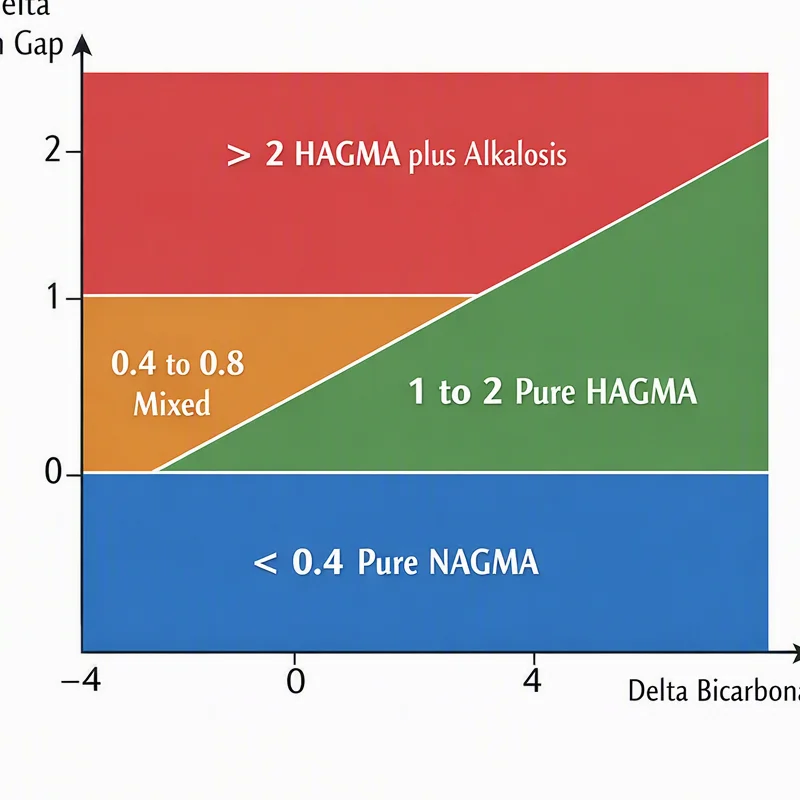
- Evaluate the delta gap if the anion gap is elevated to look for additional disorders.
The delta analysis helps identify whether the rise in the anion gap is proportional to the fall in bicarbonate. If the change does not match expectations, a mixed acid-base disorder may be present. This matters because a patient can have more than one process at the same time, such as high anion gap metabolic acidosis plus metabolic alkalosis from vomiting.
The compensatory response should always be assessed because the body responds predictably to primary metabolic disturbances. For example, in metabolic acidosis, the respiratory system usually lowers CO2 through hyperventilation. If compensation is absent or excessive, another process may also be occurring.
This framework turns the anion gap calculator into more than a formula tool. It becomes part of a broader structured assessment of the patient’s acid-base status.
Typical Pitfalls In Using an Anion Gap Calculator
One common pitfall is overlooking albumin. As hypoalbuminemia decreases the apparent gap, students may miss a clinically important high-gap state unless they apply the corrected anion gap. This is particularly important in critically ill patients, where low albumin is common.
Another problem is relying on the calculator without checking the actual lab values. The anion gap is only useful if sodium, chloride, and bicarbonate are reliable and comparable. A single transcription error can change the result enough to affect the interpretation.
Students also sometimes forget that a “normal” value does not rule out disease. A patient with severe hypoalbuminemia may have a deceptively normal result even in the presence of significant acid generation. Likewise, a mixed acid-base disorder can hide behind a seemingly straightforward number.
Other common mistakes include:
- Failing to check the laboratory’s reference interval.
- Ignoring the role of measurement error in electrolyte testing.
- Not linking the result with the patient’s symptoms and diagnosis.
- Assuming all metabolic acidosis is high gap.
The best habit is to view the calculator as an assistant, not a replacement for thinking. Accurate interpretation requires integrating the result with the clinical story, blood gas analysis, and the broader metabolic context.
Practice Examples for Medical Students
Example 1: A patient presents with a serum sodium of 138, serum chloride of 100, and serum bicarbonate of 14. The anion gap is 24, and it is elevated. This pattern clearly suggests high-gap metabolic acidosis. The next step is to think about causes including lactic acidosis, diabetic ketoacidosis, and renal failure-related acidosis, then correlate with vitals, glucose, creatinine, and lactate.
Example 2: The patient presents after several days of marked bowel losses. Serum sodium is 140, serum chloride is 112, and serum bicarbonate is 18. The anion gap is 10, which is within the usual range. This is in keeping with non-gap metabolic acidosis caused by acid-base buffer loss. The chloride elevation supports a hyperchloremic pattern.
Case 3: In a patient with advanced kidney disease, there are sodium 135, chloride 98, and bicarbonate 15. The anion gap is 22, which suggests retained acids and possible renal uremic acid retention. When albumin is low, the albumin correction may reveal an even higher corrected value. That adjusted result gives better clinical interpretation than the raw number alone.
Clinical case 4: In a patient with type 1 diabetes, there is sodium 130, chloride 95, bicarbonate 8, and signs of dehydration. The findings point to ketone-driven acidosis. In this situation, the anion gap calculator helps confirm the presence of a high-gap metabolic process, but treatment decisions depend on the full clinical picture, including glucose, ketones, potassium, and blood gas analysis.
These cases show that the calculator is only a starting point. What matters most is connecting the number with disease mechanism, diagnosis, and management.
Frequently Asked Questions
What is an anion gap calculator used for?
An Anion Gap Calculator is used to calculate the difference between measured cations and anions from routine labs. It helps evaluate metabolic acidosis, identify unmeasured acids, and guide the diagnostic approach to acid-base problems. It is especially helpful for spotting high-gap metabolic acidosis and deciding whether albumin correction is needed.
How is calculated the anion gap with lab results?
Use the anion gap equation: sodium less the total of chloride and bicarbonate. In formula form, it is sodium − (chloride + bicarbonate). Enter the values into an anion gap calculator to limit arithmetic mistakes, then match the result with the local reference range.
What represents a normal anion gap range?
The reference interval is based on the laboratory method and whether potassium is included. Several laboratories use a non-potassium range around 8 to 12 mEq/L, but students should always use the institution’s stated reference interval. A “normal” value must also be understood in light of albumin and the full clinical setting.
Why is it corrected the anion gap for albumin?
You modify for albumin because it is a major unmeasured anion. In hypoalbuminemia, the measured gap may appear falsely low or normal, which can hide a true acid-base problem. Albumin correction gives a more accurate corrected value and improves clinical interpretation.
What can cause a high anion gap metabolic acidosis?
Major causes include lactic acidosis, ketoacidosis, and uremia. These conditions increase unmeasured ions and lower bicarbonate, producing high anion gap metabolic acidosis. A careful review of the arterial blood gas, electrolytes, kidney function, glucose, and lactate helps identify the cause.